
Editor's Letter
by Andrew Page
“The old order changeth, yielding place to new …” —Alfred Lord Tennyson, Idylls of the King (1885)
In 2006, when the family of Benjamin Heineman donated 240 objects from his renowned glass art collection, it was hailed as the definitive historic exhibition of Studio Glass, and The Corning Museum published a lavish catalogue and kept a rotating mix of objects on view in the Heineman Gallery for two decades. This year, those objects were moved to make room for “Tough Stuff: Women in the American Glass Studio,” an exhibition that seeks to challenge the widely accepted Studio Glass history because it states that it had been centered on too few artists and excluded the important contributions of women working with glass. As the Corning website puts it: “Visitors will discover how work from this period by female artists illuminates the broader social, cultural, and gender politics of the time.”
Though male artists predominate in the Heineman Collection, female artists are far from absent, and works in the collection by Jane Bruce, Flora Mace and Joey Kirkpatrick, Ginny Ruffner, Karla Trinkley, Ann Wolff, and Toots Zynsky were reinstalled in the new exhibition. The Corning exhibition, the first organized by Tami Landis, the curator of postwar and contemporary glass, zeroes in on women experimenting with glass during the 1960s and 1970s, which, according to the exhibition announcement, has been “mostly overlooked in research, scholarship,collection, and exhibitions,” and credit has gone to only “a few makers.”
With the release of essays in the exhibition catalogue (see Hourglass, p. 13), new scholarship will broaden our understanding of the evolution of Studio Glass as it continues to develop in newdirections in the new century. We hope issue’s in-depth article on Ann Wolff adds to this expanded history of Studio Glass and beyond.
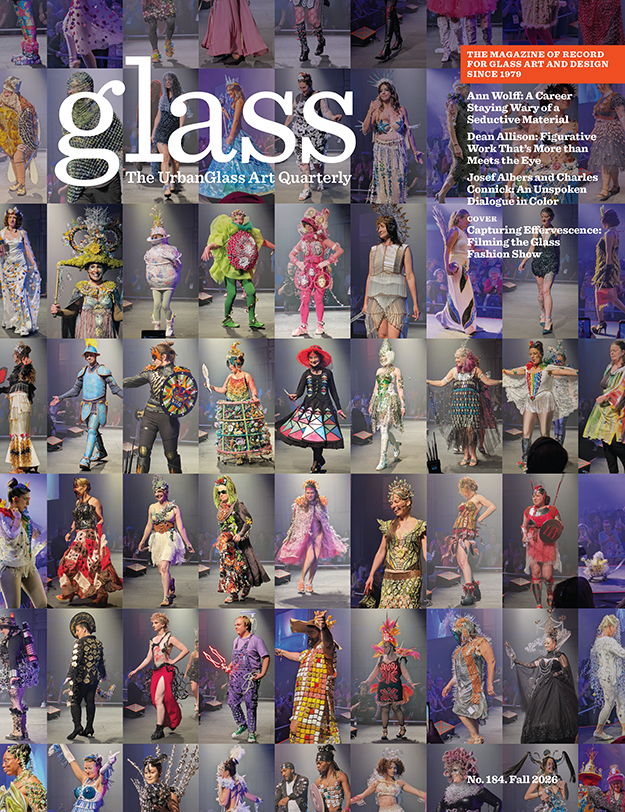
On the cover of this issue is a photo collage from the Laura Donefer’s beloved Glass Fashion Show that captures some of its effervescent energy. In the accompanying feature article, Doneferdiscusses its history and future, which includes a project to document this unique phenomenon on film to ensure its legacy.
Contributing editor Samantha De Tillio looks at the overlap between the color theories of Josef Albers and stained glass artist Charles Connick, and artist John Moran investigates the figurative work of Dean Allison, examining all the ways it transcends realism and becomes something conceptual as well.