
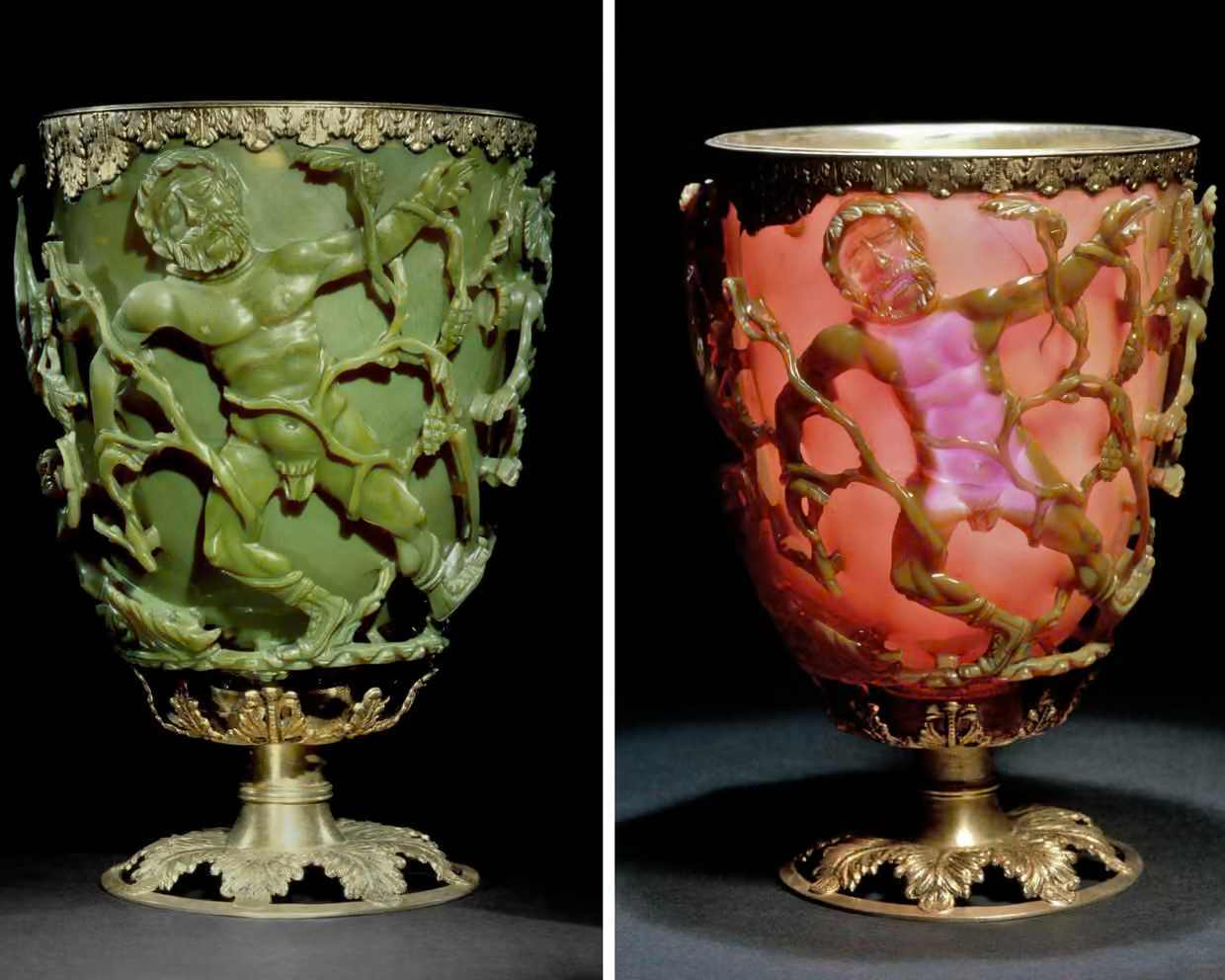
In the transfixing interplay of color and light, glass can take on a magical allure, which has never been more entrancing than the 1,600-year-old Roman Lycurgus Cup, on permanent view at the British Museum in London. A rare intact cage cup, it is made with an extremely rare dichroic glass that appears jade green in reflected light and ruby red when illuminated from behind. Until recently, how these magical effects were achieved confounded even contemporary researchers who were unable to reproduce the unique qualities, making the ancient cup an alchemical mystery. But now, thanks to a breakthrough by researchers at the University of Sheffield, the secret is being understood.
By studying a fragment from the original cup, researchers at the University of Sheffield were able to reproduce the same optical effect by incorporating gold and silver nanoparticles into molten glass. As the glass cools, depending on the direction from which light reaches the material’s surface, these particles block certain colors.
In an interview with The Guardian newspaper, Sheffield technician Dr Lisa Hollands explained that “If light is shone through it, the gold and silver particles block blue and green light, only allowing reds and oranges to pass through. If light is reflected off the surface, the particles have the effect of scattering the light, giving the opaque green colour we see.”
The video above shows these color-changing glass effects brought to life in a contemporary glass sculpture by artist Elliot Walker, who was commissioned by the university to make a replica of an ancient roman glass vessel using the newly researched glass. By bringing together references to the Lycurgus Cup and the Farnese Atlas, the work closely replicates the nuances of its “ancient twin.”
To pay homage to this achievement in connection with the ancient Roman makers, the University of Sheffield will present the sculpture at the Millennium Gallery as part of the Festival of the Mind, running through November 15, before it finds a permanent home at the Turner Museum of Glass.
Despite helping historians and glass-makers better understand how the Roman craftsmen actually worked, this discovery still leaves some questions unanswered, including how they managed to control color in the furnace. Since the resulting color is highly sensitive to the glass’s position within the furnace, achieving the desired shade must have been particularly challenging.
See a well-produced video from the University of Sheffield for more details on this scientific breakthrough.
Were Romans aware of the physical principles behind the techniques they employed? How much of their success was a matter of exceptional luck? If they had mastered control over the color-changing effects of dichroic glass, was the transition from green to red have been chosen to intentionally symbolize the ripening of grapes, echoing the scene depicted on the cup? While researchers might have solved the chemistry of its fabrication, we lack conclusive evidence to understand everything about the making of the Lycurgus Cup’s, which maintains its place somewhere between magic allure and pioneering craftsmanship, allowing its fascination to endure and continue to puzzle audiences even many centuries after its creation.