
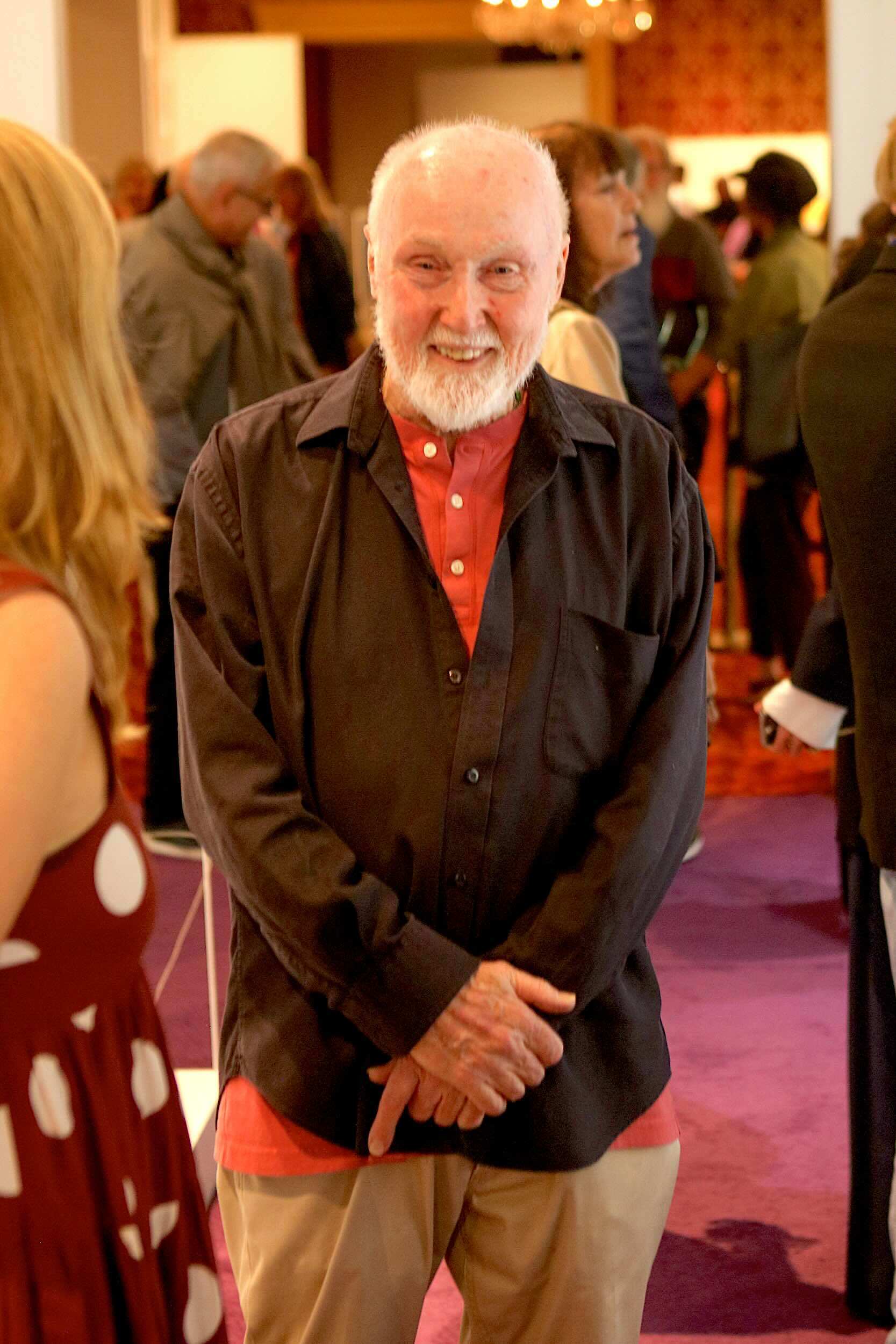
Master glass artist Paul Stankard passed away on the morning of Tuesday, October 6, 2026, surrounded by family at his Mantua, New Jersey, home tucked away on several wooded acres. Just next door stands the modest studio building where Stankard spent more than half a century redefining the American botanical sculpture, crafting startlingly lifelike flowers from flameworked glass, then encasing them in various clear glass forms ranging from orbs to standing rectangles. Where the paperweight historically had been a production item, Stankard took a different approach, making one-of-a-kind depictions of American wildflowers, complete with roots and accompanied by berries, insects, and nuts. These variations came later in his long and productive career, which began after he started experimenting with creative expression in flameworked glass, eventually leaving his first career as a scientific glassblower behind in 1972 to work exclusively on his artwork.

Stankard was featured in a cover article in the Fall 2023 edition of Glass (#172), which discussed his major technical breakthroughs, such as how to keep the delicate blossoms and leaves he had crafted at the torch from collapsing when they were surrounded by molten glass:
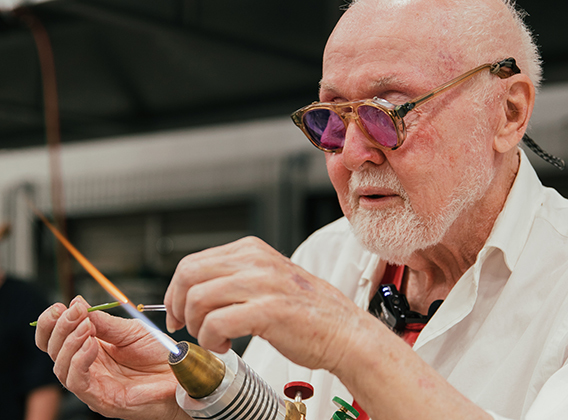
There was no college training course on how to create convincing flowers or how to successfully encase them in glass. Hours of trial and error after grueling scientific glassmaking for his full-time job yielded slow and steady progress. But some of his best early results were lost in the chaotic seconds after a large mass of molten clear glass hit the small flameworked flower—the moment of encasement. The extreme heat of the clear glass deformed the smaller delicate element beyond recognition, turning hard-won facsimile into puckered blobs distorted by air bubbles, frustrating his efforts to faithfully represent the organic forms he knew so well.
Learning how to clear-coat these fragile elements to reinforce them before the encasement took years of research on his own time. Another major Stankard innovation was depicting the root systems of flowers as well as the stems and blossoms, something never-before-seen in the centuries of paperweights. Breakthroughs like these came from painful trial-and-error, and an endless search for new ways to display the flowers that became a language with which Stankard rhapsodized about the wonders of nature; its cycles of fertility, birth and decay; and the divinity he found in the beauty of the botanical world and the insects that enabled the ecosystem.
Despite facing a series of increasingly serious health challenges for the past decade, Stankard never lost his open, generous approach or enthusiasm for his projects and those of his friends and colleagues. Arriving for a visit, or bumping into him at an event, he would greet you with an enthusiastic handshake or a hug, always happy to see you and quickly segueing to his latest initiative, eager to share his new series of botanicals — or his latest book.
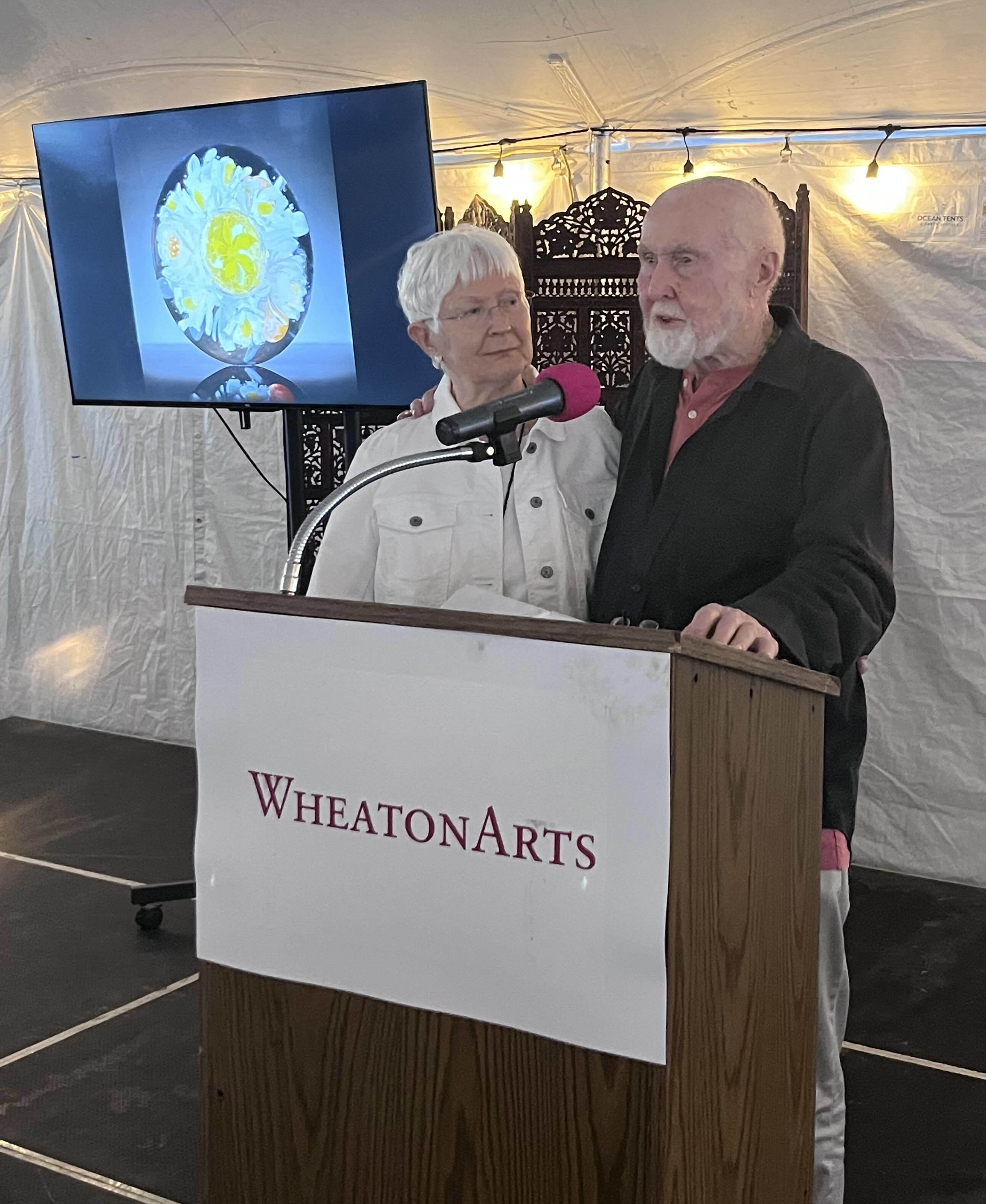
Despite having a serious learning challenge, Stankard authored four books, starting in 2007 with No Green Berries of Leaves, a bracingly honest memoir of his struggles with dyslexia and anxiety. In fact, it was through this book I first got to know not just about Stankard's life and career, but how he approached every project with enthusiasm and genuine joy. An unabashed promoter of his own work, he was never pushy but swept you up in his enthusiasm, sharing his genuine appreciation and even wonder at his own work, or the many others who he extolled. Stankard loved to connect with everybody from Italian glass masters to American pipemakers, and was eager to cross boundaries within the glass world as well as introduce people from different arenas. He played a major role in in the addition of a creative glassblowing associate degree program at Salem County Community College, where he himself learned scientific glassblowing in the 1960s. In 2001, Stankard founded the International Flameworking conference, an annual event at Salem that has grown over the years into a major gathering that brings together torchworkers from various fields. Stankard was also a longtime champion of the Creative Glass Fellowship Program at WheatonArts in Millville, New Jersey, where he was honored with an 80th birthday party in 2023.
In the 2023 cover article of Glass I wrote about his role as a networker and innovator in detail, and extended this idea to how his work links to his love of the intricacy of nature:
Paul Stankard is nothing if not a connector—from how freely he offers the insights and observations from his wide travels to help institutions grow, to connecting pipe makers to the Studio Glass movement, to connecting antique French paperweights with a decidedly contemporary approach to faithful botanical studies that incorporate magical realist flourishes, moving the entire world of paperweights and other encasements forward. But ultimately, Stankard connects us to nature, using his studies encased in glass as lenses or portholes into his privileged way of seeing the world in all its glorious details, and sharing it so generously with all who will look and listen.
A devout Catholic, Stankard grew up in North Attleboro, Massachusetts, where he was taught by Irish nuns for his elementary years. Their advice included prayers to repeat if encountering the devil, which captures something about his early experience of religious theology. Stankard told me about his forays into a patch of woods near his house that became for him an enchanted refuge as his early education was marked by his struggles with undiagnosed dyslexia. It was here he would first encounter the wildflowers that would become his muse for his entire career, and he'd gather bouquets for his mother. His impressions of the natural world, teeming with life and fecundity, were formed in this undeveloped land, and it was the woods behind his Mantua home where he would return in search of inspiration, solace, and appreciation for his faith. Stankard saw the divine in the beauty he experienced and in his efforts to depict them with a veracity that honored "the Creator." Above his studio he painted the Latin phrase labore est orare, which translates into "to work is to pray," which he connected to the Benedictine monks and their search to balance work and prayer. It is fitting that the title of his 2022 book Inspiration from the Art of Paul J. Stankard : A Window into My Studio and Soul made the connection between his work and faith even more explicit.
In the introduction to the 2011 book Beauty Beyond Nature: The Glass Art of Paul Stankard, I noted the the incredible act of self-invention that Paul Stankard performed when he made the decision in 1972 to drop scientific glassblowing and devote himself entirely to his creative pursuit of botanical works in glass. He struggled in school and eventually pursued a vocational education in part because of the self-doubt that came with his troubles understanding written texts due to his learning disabilities that hadn't yet been diagnosed. He sought escape as well as inspiration in the natural world. His scientific career was especially challenging for him when he had to read complex diagrams of the work needed. Despite having a young family to support, and a mortgage to pay, he would embark on a new direction — which he never failed to credit to the dedication and support of his wife, Patricia — and take the world of art along for the ride. As I wrote: "With a resume marked by a series of retreats from the challenges of dyslexia, his bid to remake himself as an artist was a brazen act of self-determination."
Those who knew him were richer for Paul Stankard's friendship, as is anybody who peers into the clear glass that suspends his bouquets of flowers be gathered up and arranged, sharing in the glory of nature's beauty Stankard gave freely to all willing to spend a few minutes marveling at the work of his hands and imagination. Anyone looking to be illuminated by the bright light of Paul's creative life and work should seek out some of the books and articles listed above, or watch filmmaker Dan Collins' breathtaking documentary Paul J. Stankard: Flower and Flame. Through the sheer power of technique and pure intentions, Stankard's work lives on to charm, inspire, and reveal new insights and ways of seeing for the generations to come.
Paul J. Stankard (1943–2026) is survived by his wife, Patricia, and his children Christine, Katherine, Pauline, Joseph, and Philip. This article will be updated with any information about funeral arrangements or memorial service.